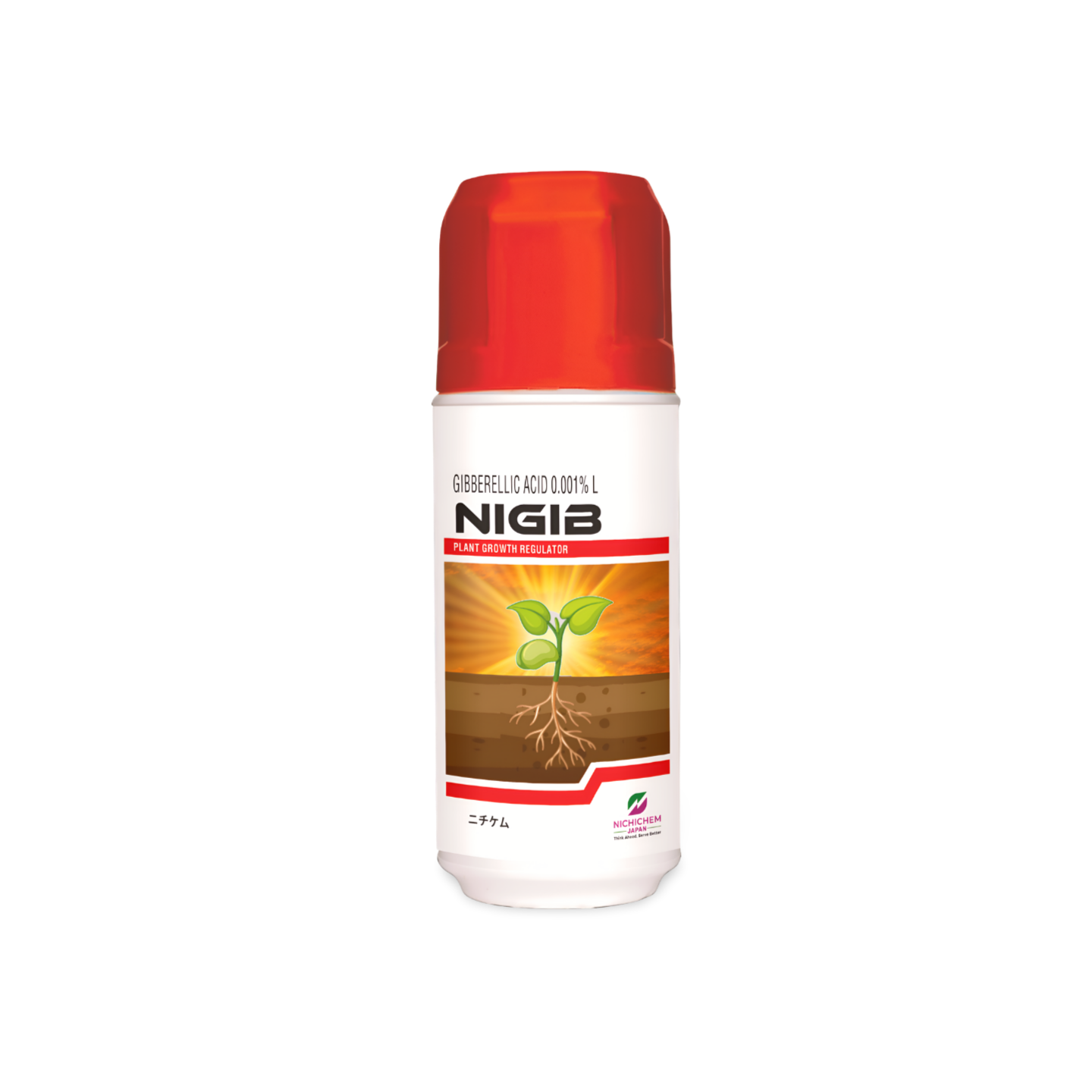
NIGIB+ – Gibberellic Acid 0.001% L is a highly effective plant growth regulator formulated as a liquid (L). It stimulates plant growth by promoting cell division, elongation, and overall metabolism. NIGIB+ helps enhance seed germination, flowering, fruit setting, and crop uniformity, resulting in healthier, more vigorous plants and improved crop yield and quality. It is suitable for use on cereals, vegetables, fruits, and ornamental crops.
Mode of Action
Hormonal Growth Stimulation: Gibberellic Acid mimics the natural plant hormone → stimulates enzyme production → enhances cell elongation and division → improves photosynthesis and nutrient mobilization.
Systemic Effect: Absorbed through leaves and roots → translocated to growing parts → promotes uniform growth, earlier flowering, and better fruit development.
Regulates Developmental Processes: Accelerates seed germination, flowering, and fruit growth → ensures optimal crop performance.
Benefits
Promotes uniform plant growth – Improves stem elongation and leaf expansion for strong plant structure.
Enhances flowering and fruit setting – Supports better fruit size, uniformity, and crop quality.
Boosts seed germination rate – Improves early plant establishment.
Increases yield and crop quality – Better flowering and fruit set lead to higher marketable yield.
Supports early growth stages – Enhances seedling vigor and uniformity.
Easy application – Liquid formulation for simple dilution and foliar spray.
Safe and efficient – Effective at low concentrations with no adverse crop effects when used as directed.